New here? Start with Getting Started for hands-on examples, then return here for deeper understanding.
- Context Layer. Knowledge graphs, GraphRAG retrieval, semantic embeddings, and temporal intelligence ground every LLM response in structured, queryable facts.
- Accountability Layer. Provenance tracking, decision intelligence, conflict detection, and W3C PROV-O compliance make every claim in your AI stack auditable and explainable.
- Extension Layer.
PluginRegistryandMethodRegistrylet you replace or augment any component (ingestors, extractors, reasoning engines, backends) without changing framework code.
Knowledge Graphs
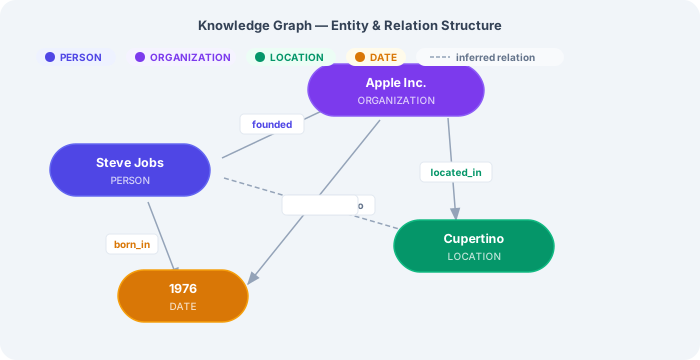 The foundation of everything in Semantica. A knowledge graph stores information as three building blocks:
- Nodes (entities): people, companies, locations, events, concepts
- Edges (relationships):
works_for,located_in,founded_by - Properties: name, date, confidence score, source URL
Entity Extraction (NER)
Scanning text to find and classify real-world entities:NERExtractor(method=...).extract(text) returns a list of Entity objects, each
with a label, character offsets (start_char / end_char), a confidence
score, and a metadata dict recording the extraction method. Three methods are
available:
Relationship Extraction
Finding how entities connect to each other:RelationExtractor(method=...).extract(text, entities=entities) returns a list of
Relation objects: typed subject-predicate-object triples (the endpoints are
Entity objects) with confidence scores and source attribution. Extraction runs
via pattern rules, ML models, or LLMs.
Knowledge Graph vs. Vector Store
Both store information for AI retrieval: but they’re built for different jobs.- Knowledge Graph
- Vector Store
- GraphRAG (Both)
Stores structured facts as typed nodes and labeled edges. Answers questions that require understanding relationships between entities.
Use when: you need structured reasoning, provenance, compliance, or explainability.
Embeddings
Embeddings convert text into numerical vectors so AI systems can measure semantic similarity: finding related concepts even when the exact words differ. Semantica uses embeddings for:- Semantic search: retrieve by meaning, not just keywords
- Entity resolution: match the same entity across different sources
- Precedent search: find similar past decisions
- GraphRAG retrieval: hybrid vector + graph traversal
- Distance Intelligence: N×N semantic distance matrices between any node set
GraphRAG
GraphRAG (Graph-Augmented Retrieval Augmented Generation) enhances LLM responses by grounding them in a structured knowledge graph rather than raw text chunks alone.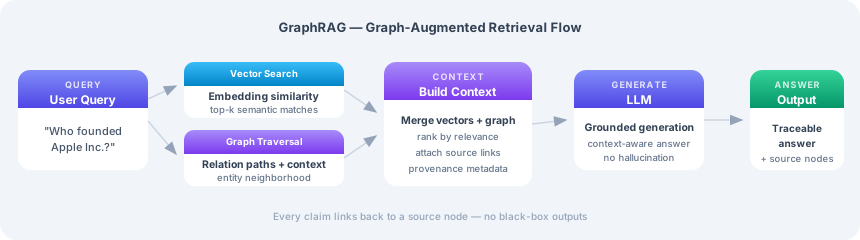
1
User submits a query
The query is embedded and used to seed both vector search and graph traversal simultaneously.
2
Hybrid context retrieval
Semantica retrieves relevant graph context: entities, typed relationships, and multi-hop reasoning paths: alongside vector-similar text chunks.
3
Context building
Retrieved facts and reasoning paths are assembled into a structured prompt context, each fact tagged with its source node and confidence.
4
LLM generates a grounded response
The LLM produces an answer where every claim links back to a source node in the graph: no floating assertions, no hallucinations from training data.
Ontology
An ontology defines the schema and rules for your knowledge: what entity types exist, which relationships are valid, and what constraints apply.Reasoning & Inference
Semantica includes multiple reasoning engines to derive new knowledge from existing facts.- Forward Chaining
- Rete Network
- LLM Reasoning
- Datalog (v0.4.0)
- Engine Comparison
Applies IF/THEN rules repeatedly until no new facts can be derived. Best for alert systems, compliance checks, and trigger-based workflows.
Reasoner.forward_chain() returns InferenceResult objects that carry the rule
applied (rule_used) and the premises it fired on, and ExplanationGenerator
turns one into a step-by-step natural-language justification: reasoning here is
not a black box.
Temporal Intelligence
Knowledge changes over time. Temporal graphs attachvalid_from / valid_until windows to nodes and edges, enabling point-in-time queries and historical analysis.
recorded_at stamping, temporal provenance.
Common uses: tracking company leadership changes, policy evolution, research timelines, financial instrument histories, regulatory compliance windows.
Distance Intelligence
Explore the semantic neighborhood of any entity in your graph: useful for understanding what’s conceptually close, detecting clusters, and visualizing knowledge topology.direct / near / mid-range / distant), embedding cache optimization for large graphs.
The Visualization module renders distance matrices as interactive heatmaps and ego-mode neighborhood graphs. The Explorer embeds distance intelligence directly in the browser dashboard.
Deduplication & Entity Resolution
Real-world data contains the same entity under many names: “Apple”, “Apple Inc.”, “Apple Computer Inc.” Semantica’s deduplication pipeline detects these, merges attributes, resolves conflicts, and preserves the original source provenance.- Strategies
- Configuration
Provenance & Auditability
Every fact in Semantica links back to:- The source document it came from
- The extraction method used (pattern / ML / LLM)
- The ontology rules applied during graph construction
- The reasoning steps that produced any inferred fact
This is W3C PROV-O compliant lineage: suitable for regulated industries that require audit trails (HIPAA, SOX, GDPR, FDA 21 CFR Part 11).
ProvenanceManager.export_prov(format="turtle") serialises the recorded lineage as PROV-O RDF.Decision Intelligence
Every agent decision is a first-class object in Semantica: recorded, causally linked, and searchable by precedent. This is the accountability layer for AI pipelines: decisions are no longer ephemeral log messages, they are queryable knowledge graph nodes.Conflict Detection
When multiple sources disagree on the same fact, Semantica flags and resolves the conflict rather than silently picking one value. Resolution strategies:- Recency: prefer the most recent source
- Source credibility: prefer the most reliable source (configurable credibility scores)
- Majority vote: aggregate across all sources with ≥ 2 agreeing
- Manual review: flag for human arbitration; continue pipeline without blocking
ConflictResolver, SourceTracker, and InvestigationGuideGenerator.
Custom Plugin Development
Semantica is designed for extension. Any component: ingestor, extractor, graph builder, reasoning engine: can be replaced or augmented with a custom implementation registered at runtime.PluginRegistry: replace any component by name
PluginRegistry: replace any component by name
PluginRegistry provides dynamic plugin discovery, registration, and loading across all modules. Register your own class under a string key; Semantica will use it wherever that key is referenced in config or pipeline steps.MethodRegistry: swap a built-in graph operation for your own
MethodRegistry: swap a built-in graph operation for your own
method_registry lets you register an alternative implementation for a
knowledge-graph task (build, analyze, centrality, resolve, …) under a
name, then select it wherever that task runs.- Quickstart Tutorial: build a full pipeline with code.
- Modules Guide: every module explained with examples.
- API Reference: complete technical reference.